🧪 RAG‑LCC Your local RAG experimentation lab. Identify where RAG fails


Built with & integrates:
AI, retrieval & language:








Configured LLM families:



Document processing:


Service & optional integrations:




Jump to a topic
- Overview · Who this is for · Presentation
- What you get · Application suite · Why this project is different
- Quick start · Query and grounding examples · Documentation hub
- Installation · Hands-on tour · Source repository
Overview
Experimental Retrieval-Augmented Generation under constraints.
RAG-LCC is a practical lab for understanding where RAG systems fail and how to fix them: retrieval misses, context poisoning, multilingual drift, and compliance edge cases.
Who this is for
- Researchers and practitioners exploring why RAG pipelines succeed or fail
- Engineers working with large, multilingual, or conflicting document sets
- Teachers and students learning RAG internals through hands-on experimentation
- Anyone debugging multi‑turn chat‑context failures in RAG systems
- Users running RAG on constrained or commodity hardware
- People who want to experiment beyond “embed + cosine + top‑k”
Short: If you want to understand why your RAG fails, RAG-LCC gives you a playground to experiment with the parameters that matter. You can tune settings, compare alternatives on a small test corpus, and carry those insights back into your own RAG. In other words, RAG-LCC is an insight tool with reusable ideas, not an everyday production RAG.
Presentation
View or download the PowerPoint presentation, or watch it play below:

The presentation also highlights tabular answers, document summarization, and the optional web-retrieval leg.
What you get
- Hybrid retrieval pipeline with Vector, BM25, Graph, and Regex retrieval
- Multi-turn chat support with query rewriting and topic switching
- Document summarization across all indexed chunks of a selected document
- Optional web retrieval to augment local results with live web content
- Multi-query expansion for better recall
- Cross-encoder reranking and strategy-based context assembly
- Configurable orchestration flows for per-turn pipeline control
- Confidence evaluation signals for evidence-quality tuning
- Optional answer-quality judge with named-model output and aligned scores; flat CSV exports expose individual metrics and repeated pipeline steps
- Compliance filtering during ingestion, query, and answer phases
- Grounding markers to inspect matching evidence; overlap does not establish accuracy
Application suite
Confidence logging, quality-scoring switches, and the judge prompt are centralized
in Config_Confidence.py. See the
configuration reference
for defaults, output sections, and the CONFIDENCE_FLAT CSV schema.
| Application | Purpose | Typical output |
|---|---|---|
| DocClassify | Classify and compress corpus content before indexing | CSV metadata used for selective loading |
| RAGLoad | Ingest and index local documents into multiple retrievers | ChromaDB + BM25 + Graph + Regex indexes |
| RAGChat | Interactive CLI RAG with grounding and safety checks | Grounded multi-turn answers |
| RAGChatService | OpenAI-compatible API wrapper for RAGChat | API endpoint for OpenWebUI and clients |
For the vLLM backend, the companion project HarinezumIgel/harinezumigel-llm-stack provides configuration-driven orchestration for self-hosted LiteLLM and vLLM deployments. Use it to serve the LLMs, embedder, and reranker required by RAG-LCC.
Why this project is different
Most RAG stacks optimize only retrieval score. RAG-LCC also optimizes context quality.
- Detects contradictory or noisy context before generation
- Handles multilingual retrieval routing by language buckets
- Makes retrieval and grounding behavior observable with debug levels
- Exposes most architecture decisions through configuration
Quick start
- Read installation guide INSTALL.md
- Load docs python ./src/Apps/RAGLoad.py –doc-dir TestDocs
- Start chat python ./src/Apps/RAGChat.py –doc-dir TestDocs
Query and grounding examples
-
QUERY_OUTPUT_EXAMPLE.md Full CLI transcript of a real RAGChat run, including startup checks, retrieval settings, configurable orchestration decisions, rerank diagnostics, grounding, and confidence-evaluation output.
-
Gentle tuning showcase for dev.io Beginner-friendly article that explains the RAG-LCC mental model, query-output reading, practical tuning paths across all four apps, plus an expert lane for orchestrator and query-rewrite tuning. Note: RAG-LCC is an experimental learning and tuning lab, not a production-ready deployment stack.
CLI grounding example: hedgehog query
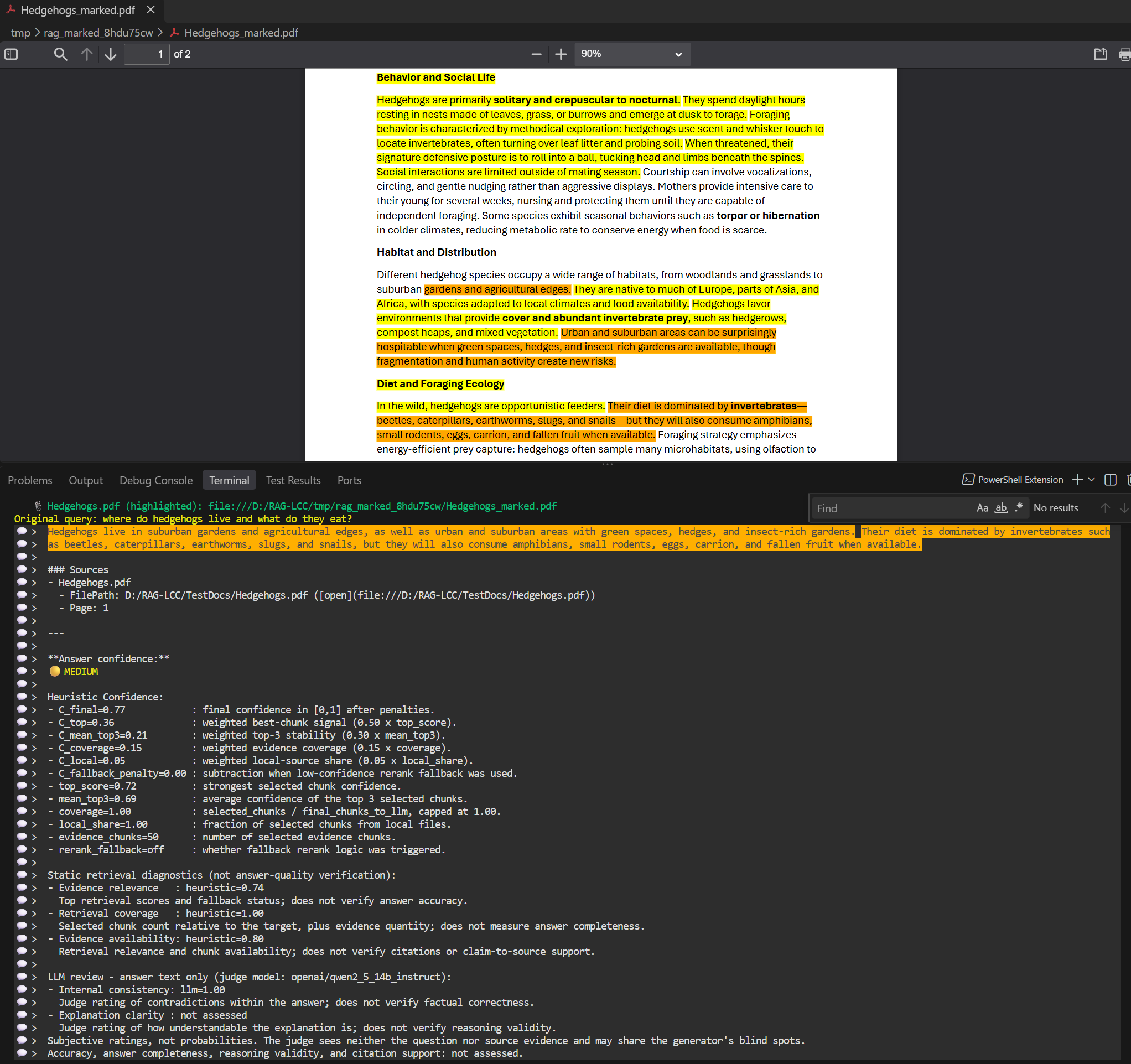
Shows sentence-level overlap markers in the CLI flow. These help inspect matching evidence but do not verify that an answer is factually correct.
Tabular answer with source grounding
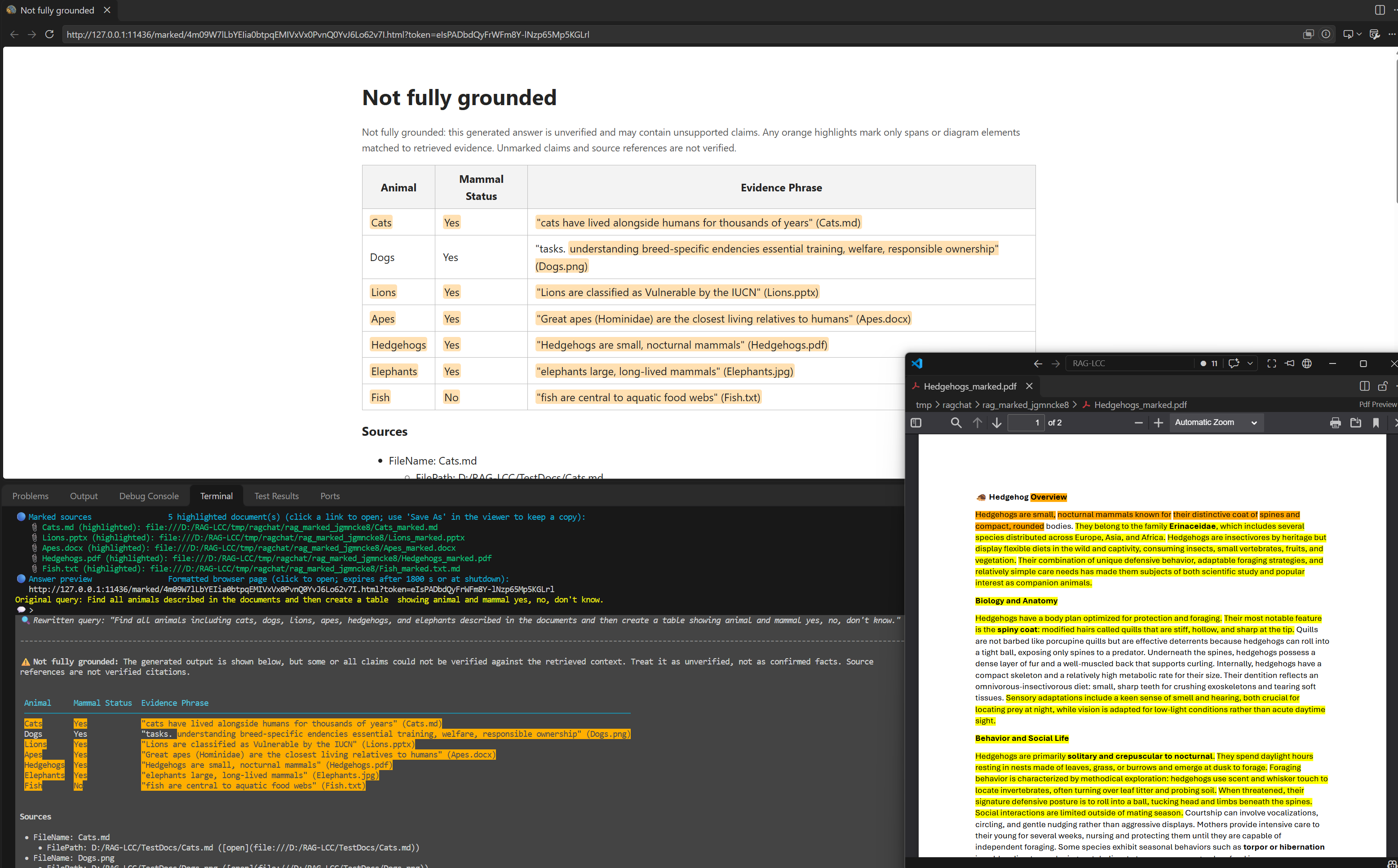
A single query can retrieve information and request a table. This example shows an animal classification table alongside highlighted passages in the source documents. The highlights help inspect matching evidence; they do not establish answer accuracy.
Mermaid diagram with grounding
Mermaid diagrams can be viewed by through the RAGChat in memory web server.
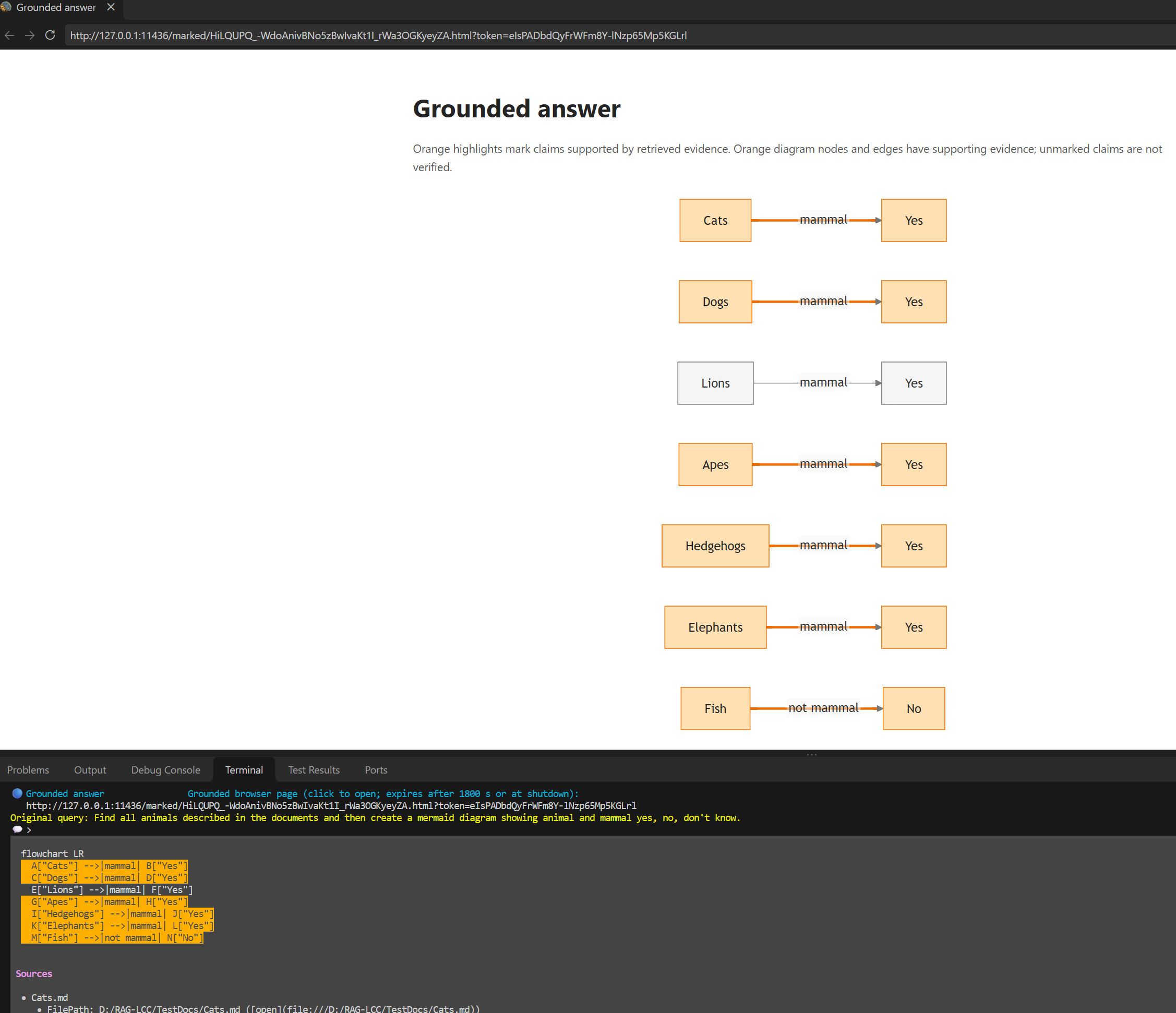
OpenWebUI example (web)
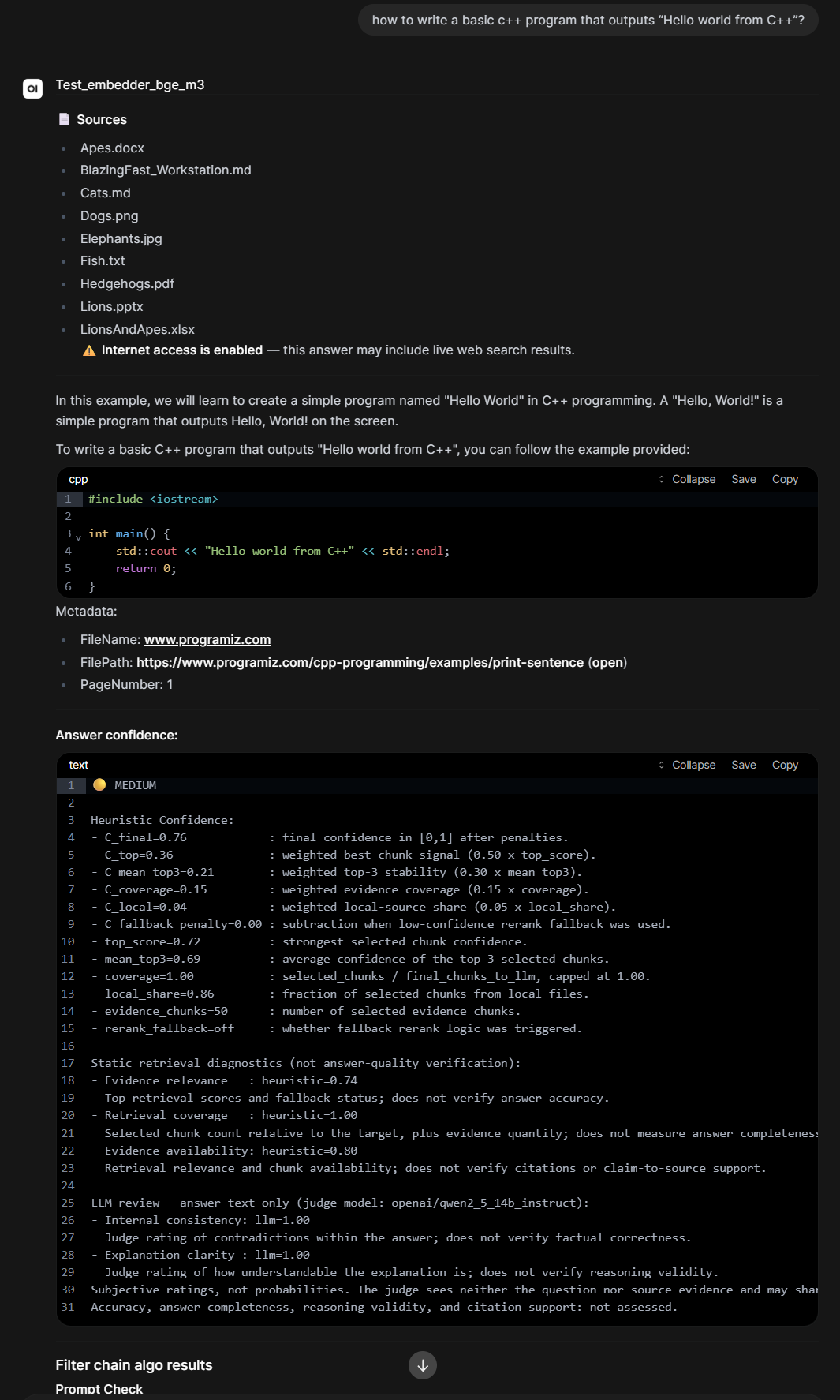
Shows the same grounding concept through the OpenWebUI integration path
(RAGChatService). Useful for validating that API/UI output preserves
evidence links, not just CLI output; matching text is not proof of accuracy.
OpenWebUI grounded example (local results)
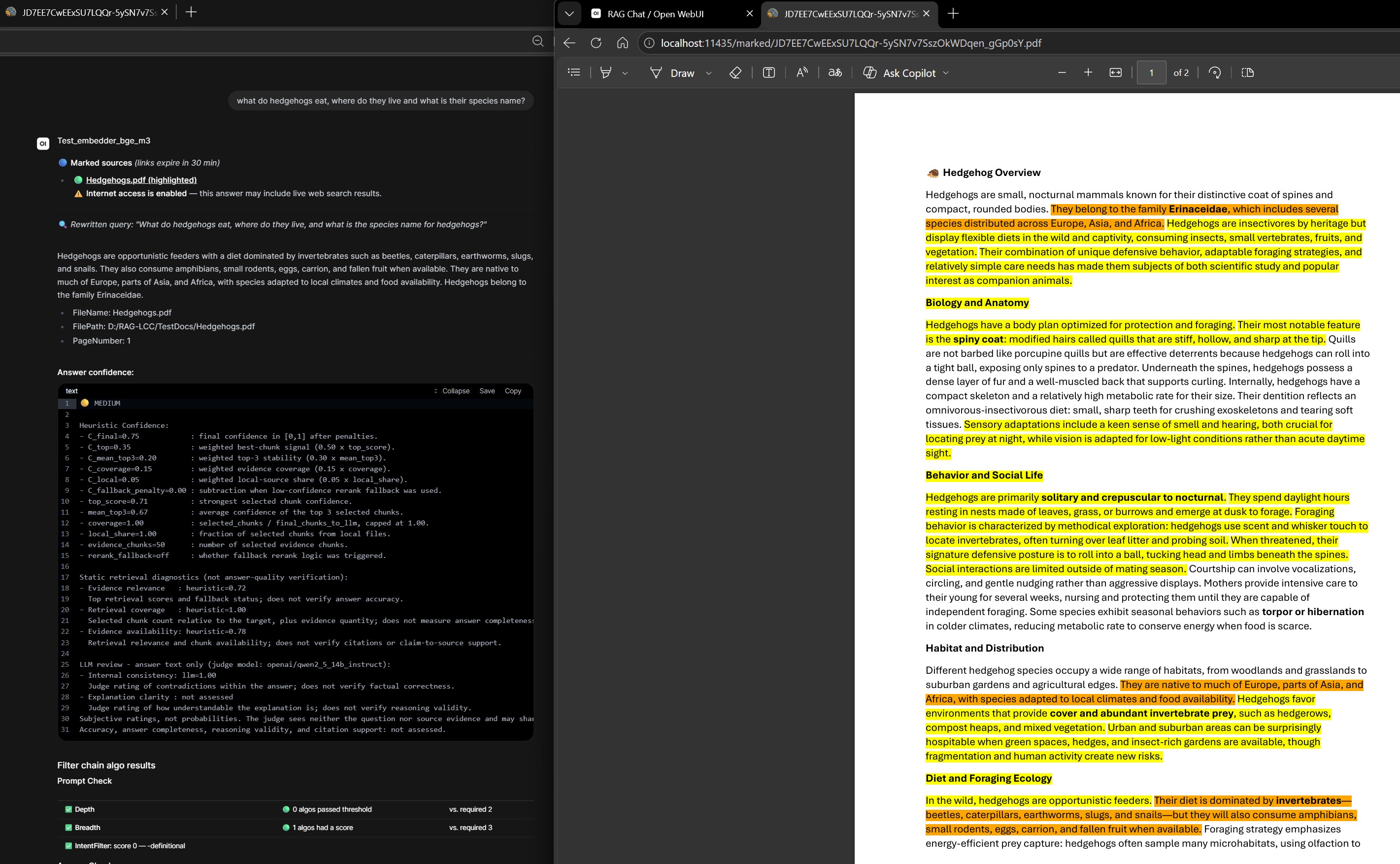
This example shows an OpenWebUI answer with source attribution, including a web result. Source links help inspect retrieved evidence but do not prove answer accuracy.
Documentation hub
- Project overview README.md
- Installation INSTALL.md
- Full configuration reference CONFIGURATION_REFERENCE.md
- Architecture deep dive ARCHITECTURE.md
- Query output walkthrough QUERY_OUTPUT_EXAMPLE.md
- Hands-on tour HANDS_ON_TOUR.md
- Legal and compliance notes LEGAL.md
Source repository
⭐ Support the Project
RAG-LCC is developed in personal time and continues to evolve through community interest, feedback, and experimentation.
If the project helped you, please consider:
- Starring the repository
- Sharing it with colleagues and friends
- Reporting issues and ideas
The RAG-LCC Experimental Lab runs on curiosity, feedback, and GPUs converting electricity into heat. Community interest is a major motivation for continued development.